Oriental Poppy
1 entry found.
Oriental Poppy
Common Name: Oriental Poppy
Botanical Name: Papaver orientale (Pa-PAH-ver or-ee-en-TAH-lee)
Decorative Life: 5-7 days.
Post Harvest Care:
- Using P. nudicaule, reports published in 1936 and 1938 state that flower life benefits from the cut stem ends being placed in boiling water for a few seconds after recutting at wholesale or retail levels. Other reports in 1950 and 1958 state that a 30 second dip of the cut stem ends in boiling water is essential. No recent report was found that addresses this subject.
- Finally, a 1917 report states that cut stem ends should be charred until they are crisp (not merely singed) using a candle flame or something similar.
Harvest Instructions: Should be harvested when the buds have split such that the color can be seen underneath.
Family Roots:
- Member of the Papaveraceae (poppy family).
- Native to SW Asia.
- Related genera include Dendromecon, Meconopsis and Romneya.
Personality:
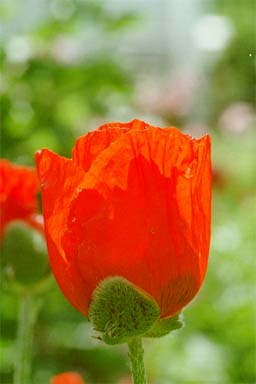
- Has four papery petals around a dark center composed of many stamens, solitary at stem ends.
- Stems are leafless, hairy, wiry, up to 24 inches long.
- Plant is a herbaceous perennial, classed as a dicotyledon.
- Flowers are not fragrant.
Availability: Spring - summer.
Flower Color: Orange-red, white, pink, yellow, salmon, watermelon, often with a contrasting spot near the center.
Storage Specifics: 36-41 F, in water for short time. Store upright to prevent geotropism (stem bending).
Tidbits:
- Poppies thrive in freshly turned soil, and grew by the millions in France during World War I. The ground was churned in battle, and as a consequence the Poppy has long been associated with war. The Opium Poppy has been used medicinally since ancient times, and its name comes from Latin "somnus" for sleep.
- The specific epithet name "orientale" refers to its origin, Far East or China.
- Papaver is an old Latin name for poppy.
- The seed pods are often used dried in arrangements. They are barrel-shaped with a fringed crown on top.