King Protea
1 entry found.
King Protea
Common Name: King Protea
Botanical Name: Protea cynaroides (pro-TEE-a sin-a-ROY-deez)
Decorative Life: 10-20 days.
Post Harvest Care:
- Remove bottom leaves if present, recut stems under water and place into a fresh flower food solution.
- Leaf blackening due to low light, keep in well-lit situation.
Family Roots:
- Member of the Proteaceae (protea family).
- Native to South Africa.
- Common relatives include Grevillea, Leucodendron, Leucospermum and Banksia.
Personality:
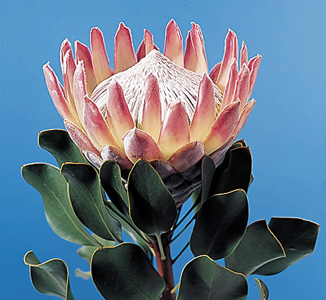
- Numerous flowers in dome-shaped heads, 12 inches across, surrounded by stiff colored bracts, giving a crown-like appearance.
- Stems with leathery leaves, cut to various lengths.
- Plant is an evergreen shrub, classed as a dicotyledon.
- Flowers are not fragrant.
Availability: Year-round of one type or another.
Flower Color: Range from pink and white to red.
Storage Specifics: 32-34 F, provide light during storage to prevent leaf blackening. Use fresh flower foods before storage also to reduce/prevent leaf blackening.
Tidbits:
- Named after Proteus, a Greek sea god with the power of prophecy. The species name of cynaroides refers to the plant's resemblance to artichoke whose Latin name is Cynara.
- In 1976, the King Protea (P. cynaroides) was designated the national flower of South Africa. Need very little care in the landscape.
- King types can grow as large as 3-4 feet tall with flowers 8-10 inches in diameter with white centers. Pink Ice is one of the most popular cultivars.
- Spectacular focal points in contemporary arrangements, the durable Protea will often bloom for several months.
- Suitable for drying. Leaves can turn black due to low light and especially due to lack of carbohydrate. Therefore, make sure a fresh flower food containing sugar is used.