Golden Solidaster
1 entry found.
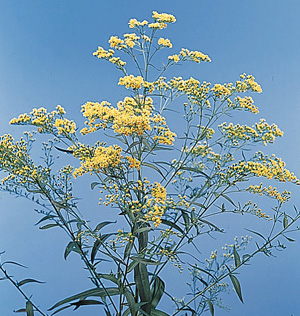
Golden Solidaster
Common Name: Solidaster, Aster, Golden Solidaster
Botanical Name: X Solidaster luteus (so-li-DAS-ter LOO-tee-us)
Decorative Life: 7-10 days.
Post Harvest Care:
- Remove bottom leaves if present, recut stems under water and place in plain tap water containing regular household bleach at 20 drops (1/4 teaspoon) per quart.
- Can be stored dry 5-6 days at 36-41 F.
Family Roots:
- Member of Asteraceae or Compositae (aster family).
- Native of France.
- Common relatives include sunflower, daisy, gerbera, chrysanthemum and lettuce.
Personality:
- Many small daisy-like flowers in loose, branching clusters at stem ends.
- Stems leafy, 18-24 inches long.
- Plant is a herbaceous perennial, classed as a dicotyledon, leaves not parallel veined.
- No fragrance.
Availability: Nearly year-round.
Flower Color: Yellow.
Storage Specifics: 32-38 degrees F.
Tidbits:
- Solidaster is an intergeneric hybrid, a cross between Aster and Solidago (goldenrod) originating in Lyon, France at the Leonard Lille Nursery in 1910. The "X" in front of the genus name indicates that it is a cross between two genera. The specific epithet name "luteus" means yellow, in reference to the flower color.
- Is sometimes mistakenly identified as Solidago missouriensis.
- The Compositae or aster family is vast, with over 20,000 species, and is also one of the most developed families. It was named Compositae because the flowers are actually a "composite" of many individual flowers into one head. Hence, when children pull one "petal" off at a time, saying "she/he loves me, loves me not", they are actually removing a complete flower, not just a petal.
- Good as a filler.
Recent Findings: Reid (2000) demonstrated that flower food effectiveness varied greatly depending on brand name compared to plain tap water and a bleach/tap water solution.